The Creative Paradox of AI and the Rise of In-House Agency
25 Mar 2026
By Roland Glass, Chief Commercial Officer (not AI)
“Will I still have a job in 5 years?”
It’s an honest question, and one that I hear often in my line of work. However, this is not the first time in history people have feared change. Every single time a new wave of technology hits, it brings that same wave of uncertainty. But I wholeheartedly believe that creative disciplines will not just survive this shift but become invaluable.
The context
Let’s look back in time. General Purpose Technologies such as the printing press, the PC, and the internet felt seismic to the people living through them. Scribes feared the printing press would destroy their livelihood and intellectual property. Administrators were certain the personal computer would make their role obsolete.
Today, if you can generate campaign visuals in seconds, you might worry you’re no longer a designer. And if agentic AI is capable of running and optimizing entire marketing functions, is the CMO role even safe anymore?
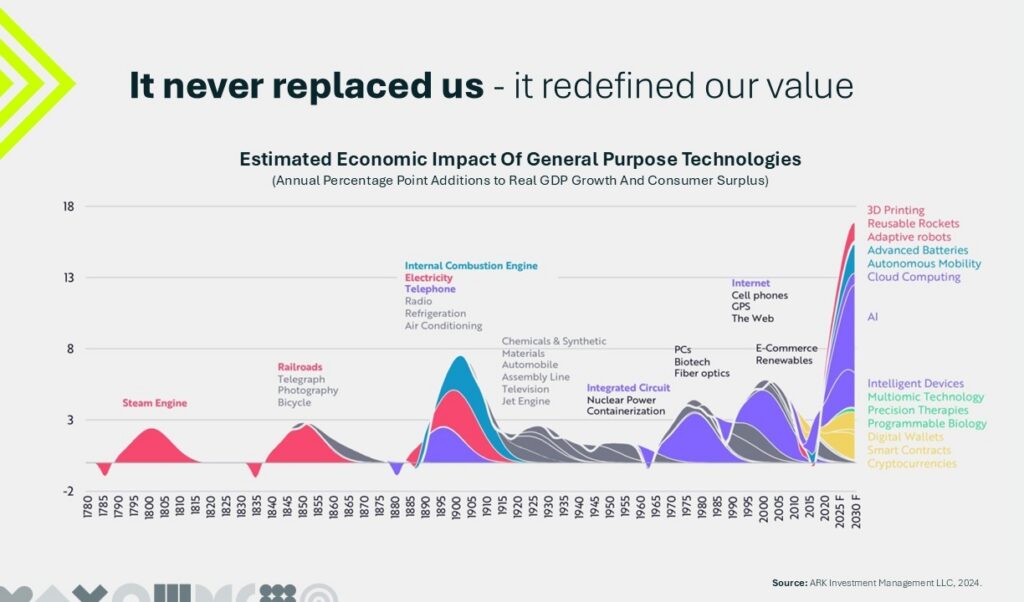
And yet, with the advent of historic innovations, productivity exploded and new industries were born. The value chain was completely redefined, and millions of people moved into more meaningful work than they ever imagined. I believe this is because technology doesn’t remove humans from the value chain—it redefines where humans create the highest value. If we look at the 200-year chart of GDP per capita and productivity waves, every GPT lifted humanity higher, not lower. The same thing is happening right now with AI.
The AI shift in marketing
In my work with HelloKindred clients, we have witnessed how marketing has moved from campaign-based work to an always-on content ecosystem. Brands are expected to show up constantly, across every channel, in every format, and in real time. It’s the most exciting, demanding work we and our clients have ever done as marketers.
Now that AI has entered the system, there are no barriers to creation anymore. Anyone can generate content. Every team can produce assets. Every campaign can multiply instantly. Content is instant, iteration is constant, and the scale is boundless.
As I have spoken about in my previous article about creative operating models, today’s production teams comprise internal teams, multiple agencies, freelancers, and AI tools, collaborating at the same time with no single center of control. We have solved for scale, speed, and volume. But what about value?
The challenge in our new creative landscape
What happens when marketing, empowered by AI, scales faster than it can be controlled?
Creative chaos.
Production multiplies, but coordination doesn’t. Brands begin to dilute. Communication starts to lose its authenticity. The customer journey becomes confusing and more fragmented. And over time, customers don’t complain, they simply disengage. Not because there aren’t enough touchpoints, but because there is no longer anything that truly resonates.
I believe that speed without control creates noise.
Added to this context is the fact that consumers have changed. They are more informed, skeptical, and pattern-aware. Emotionally disconnected and algorithm-sensitive, they are searching for resonance and authenticity. Flooding our most valued customers with high volumes of AI-generated noise is counterintuitive.
The AI paradox
The more content we produce, the harder it becomes for anyone to feel anything. Having had multiple conversations around tables with clients, we all agree that creativity that resonates most with audiences doesn’t necessarily come from output. It comes from human qualities such as joy, regret, memory, and lived experiences.
AI can simulate patterns, but it cannot live them. It has never felt the thrill of a breakthrough idea at 2 a.m., or the heartbreak of a campaign that didn’t land. And our audiences, whether they can articulate it or not, can sense the difference.
Here is the beautiful paradox: the more AI we use, the more human we need to become. As AI makes content abundant, the scarcity of real humanity becomes our greatest differentiator. As scarce things become incredibly valuable, our humanness becomes more valuable.
The shift to creative ownership
In guiding conversations with clients, we ask them about the creative capability they need to own. Because without ownership, there is no control.
This is where, I feel, the in-house agency is so crucial as a creative center of human excellence.
A place where:
- The brand is protected, and AI guardrails are set so we never dilute who we are in an ocean of infinite content
- Emotional connection is prioritized, because people buy how your brand makes them feel
- Strategy and story come before any pixel is created
- We decide which stories the brand tells and which ones it never touches
- We move from dashboards to real human insight and courageous decisions
In the noise and chaos, only humans can elevate creativity from efficient assets to emotionally resonant ideas. Only humans can protect originality in a world of AI sameness. You don’t need to be chasing more production or the latest tool. You need to focus on owning the human core of your brand in an AI-driven world.
How do creative roles change in this context?
Your role as a creative is not disappearing—it is evolving and being elevated.
We’re seeing the classic pattern of every technology wave:
- Displacement Effect, where AI takes the routine tasks
- Reinstatement Effect, where AI creates new, higher-value work for humans
Across marketing, AI is replacing execution and giving us a windfall of time and focus.
Humans now move into central roles of judgment, storytelling, orchestration, and creating real meaning. And here’s the most beautiful part: the more human-like AI becomes, the more valuable authentic human creativity will be.
When something becomes abundant, its value drops. When something becomes scarce, its value soars. AI can mass-produce content that looks human—but only real humans can prove there are real humans behind the creativity, the values, and the decisions.
In conclusion, AI is scaling content faster than organizations can scale capability. Speed without control creates noise, not advantage. When content becomes abundant, humanity becomes the differentiator. The brands that win in the next five years won’t be the ones with the most content—they’ll be the ones that still feel human.
So, the real question is no longer “Will I still have a job in 5 years?” but “Who owns the asset of humanity in your organization?”
For more on how marketing teams are evolving, you might find these articles useful: “From Cost Saver to Growth Accelerator in B2B In-housing” and “Behind the Applause: The Reality CMOs Are Facing in Marketing Teams“.