AI is on trial. Has the jury reached a verdict?
30 Sep 2026
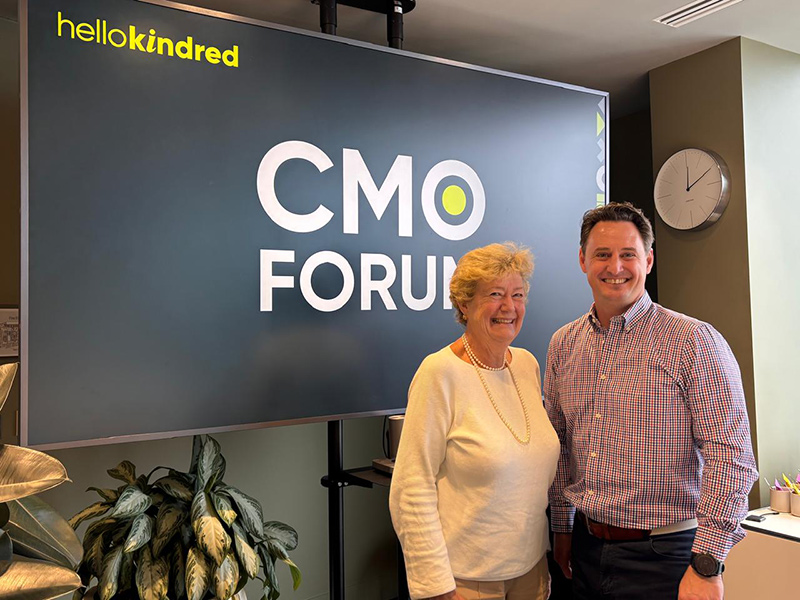
What a room full of marketing leaders revealed about AI, judgement and the changing value of experience.
This article is written by humans for humans.
There was no shortage of enthusiasm for AI at our recent CMO Forum at The Shard.
From around the table came real examples of AI doing genuinely extraordinary things.
One organization had reduced a process that previously took three to four hours to around 30 seconds. Another was using multiple agents to find stories, create content and turn it into complete suites of marketing assets.
Elsewhere, teams were using AI to understand customers, identify opportunities and accomplish more with fewer people.
This wasn’t a room debating whether AI works.
It works.
The more interesting conversation was about what happens next.
Because as AI becomes capable of doing more of the work, something else becomes increasingly valuable.
Judging whether the work is good.
“The most senior people get the most efficient use out of AI because they know when it looks good.”
That observation stopped us in our tracks.
Because perhaps the biggest question facing CMOs isn’t how much artificial intelligence they can put into their marketing organization.
It’s how much human judgement they need around it.
The “sniff test” just became a business skill
Experienced marketers accumulate something over the years that is remarkably difficult to put into a process document.
They know when something smells wrong.
A proposition that technically makes sense, but nobody will believe.
A beautifully written strategy that somehow misses the point.
A persona assembled from perfectly plausible data that bears little resemblance to an actual customer.
A campaign that’s completely on brief and completely forgettable.
Someone in the room called it the “sniff test”.
Its judgement built from years of getting things right, getting things wrong and learning lessons, meeting customers, fighting for budgets, presenting ideas, watching campaigns fly and occasionally watching them fall out of the sky.
And AI hasn’t made that experience obsolete.
If anything, it has made it more valuable.
The discussion highlighted a real concern around less experienced marketers being handed extraordinarily capable technology before they have developed the experience to judge what comes back. AI can accelerate the leap from question to deliverable, but that can also make it easier to skip the thinking in between.
AI can shorten the journey from question to answer.
Human experience tells you whether it’s the right one.
When everyone creates, everyone affects the brand
Then the conversation moved from individual judgement to something bigger.
Brand.
AI has democratized creative capability inside organizations.
Someone in sales can create a presentation. Someone in HR can make a video. Someone in finance can write a manifesto. Everyone can post on social media.
That’s liberating.
It’s also terrifying.
Examples from the room included client pitches appearing with incorrect logos and taglines, brand teams struggling to police a rapidly expanding volume of content and organizations introducing AI-powered brand guardrails to catch AI-generated work that should never have escaped into the wild.
Nobody sets out to damage the brand.
But good intentions don’t necessarily make good brand custodians.
People may know how to use the technology without understanding tone of voice, consistency, visual identity, positioning or the thousand small decisions that make a brand recognizably itself.
AI has made creating easier.
It hasn’t made knowing what to create any easier.
And something produced off-the-cuff can undo the reputation you’ve spent years building.
More AI doesn’t automatically mean more value
There was another uncomfortable theme running through the conversation.
Nobody seems entirely sure what all this AI is really costing.
Marketing leaders described expenditure buried inside technology budgets, consumption-based pricing that makes forecasting difficult, teams using multiple tools and training budgets that barely exist.
Then there are the costs that don’t appear on an invoice.
Senior people correcting mediocre output.
Brand teams policing material generated elsewhere.
Work produced faster, only to be fixed later.
Time saved at one end of the process and added at the other.
Which suggests that measuring AI by the volume it produces or the hours it apparently saves may be asking the wrong question.
What does it return to the business?
Because productivity and effectiveness are not the same thing.
Producing twice as much work in half the time is only an achievement if the work is worth producing.
AI is only as intelligent as what you give it
And underneath almost everything was data.
One comment from the room put it particularly neatly:
“All of this is not worth anything if the data underneath isn’t there.”
Clean, discrete datasets were producing remarkable results.
Messy information spread across multiple systems was considerably harder.
And marketing rarely controls all the data it needs. Sales has some. Service has some. Finance has some. Technology has some.
AI may be able to make connections at extraordinary speed.
But it can’t connect information it can’t access, doesn’t understand or shouldn’t be using.
Another reminder that the clever bit isn’t simply buying the technology.
It’s designing the team around it.
Perhaps the CMO’s job is becoming more human
For all the talk about agents, automation, models, tokens and tools, the conversation kept coming back to people.
Who directs the AI?
Who questions the strategy?
Who understands the customer beyond the dataset?
Who protects the brand?
Who recognizes the great idea?
Who spots the dangerous one?
And when something goes wrong, who takes responsibility?
There was no universal answer to every question.
But there was a pattern.
The more execution technology takes on, the more important judgement becomes.
That has interesting implications for the CMO.
Perhaps the CMO of the AI era becomes less the person responsible for producing everything and more the person responsible for deciding what matters.
Guardian of the brand.
Guardian of judgement.
Guardian of the human truth behind all that extraordinarily efficient output.
Before you consider the price of human capability,
consider the cost of not having it.
AI will keep getting better.
The question for CMOs isn’t whether to use it.
The question is how do we build a marketing organization in which artificial intelligence and human intelligence cohabit the same space.
Technology for speed and scale.
People for judgement, imagination, experience, empathy and accountability.
Because perhaps the real competitive advantage isn’t having the smartest AI.
It’s having people smart enough to know how to make the most of it.
About HelloKindred
At HelloKindred, we believe the future of marketing isn’t human or artificial. It’s about knowing where each adds the most value.
We help organizations build that balance into the way they work.
Through KindredTalent, KindredCreative and KindredTeams, we provide everything from individual specialists and project-based creative support to dedicated marketing, creative and design teams built around your business.
People with the judgement, experience and imagination to make technology more valuable, not compete with it.
Because as the tools become more powerful and accessible to everyone, we believe the things that make us human become more valuable, not less.
If you’re rethinking how your marketing or creative team should work in the age of AI, we’d love to be part of the conversation.
HelloKindred.
Human by design